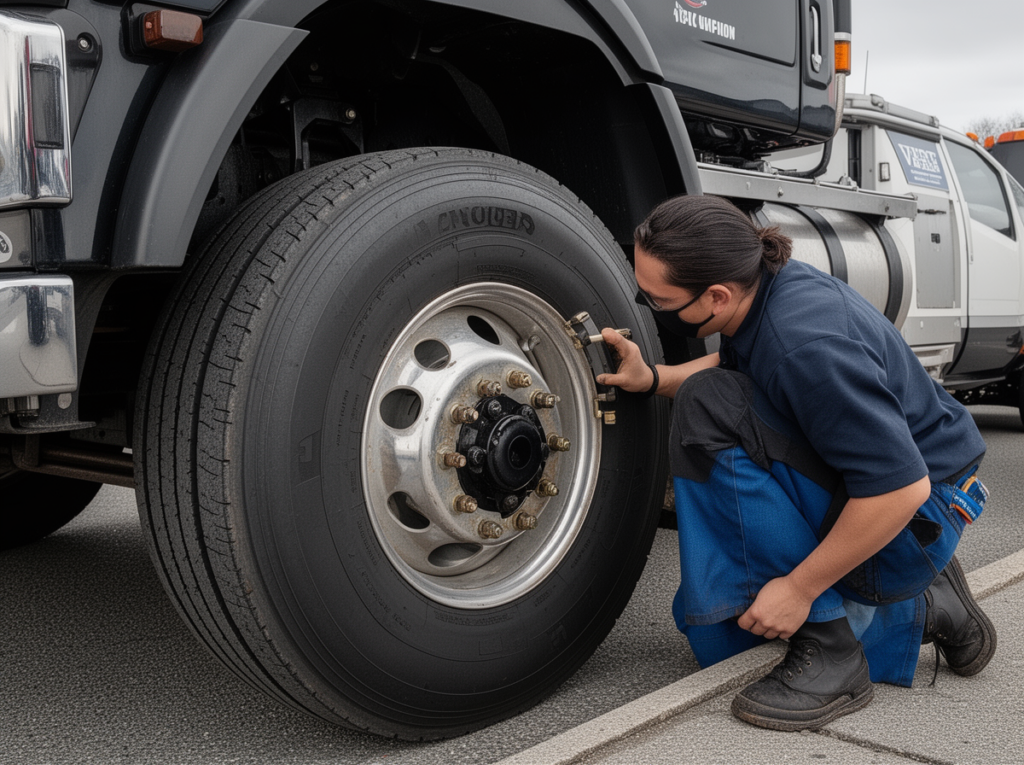
A commercial tire does not have to blow out to create a roadside problem. A tire that repeatedly loses pressure can become unsafe, damage the casing or leave a truck disabled if the source is not identified. The right roadside information begins with the full sidewall size and the exact wheel position.
Commercial truck tire losing air? Deals On Wheels & Tires provides commercial roadside assistance across Boca Raton through Fort Pierce, subject to dispatch availability. Call 561-847-4097 with the exact safe location, full tire size, wheel position and symptoms to confirm dispatch availability. This service is for eligible commercial trucks, trailers and fleets. Passenger tire sales and auto repairs are performed at our West Palm Beach shop only. No towing or guaranteed arrival time.
A tread puncture is only one possible source
Nails, screws and other road debris can create a slow leak, but the visible object is not enough to determine whether a tire is repairable. The location and extent of damage, internal condition, tire application and how far the tire was operated low on air all matter.
Valve and valve-core leaks can mimic a tire puncture
Air can escape through valve components as well as the tire itself. Report whether the valve looks damaged, whether a valve extension is involved and whether the pressure drops while the truck is parked or mainly after driving.
The bead and wheel also need inspection
The tire seals against the wheel at the bead area. Damage, contamination, corrosion or wheel problems can contribute to air loss. A repeated leak after tire service is a reason to inspect the entire sealing area instead of repeatedly adding air.
Heat, hub leakage or brake symptoms change the call
If the same wheel position also has unusual heat, smoke, wheel-seal leakage, bearing noise or a dragging brake, tell dispatch before service begins. Tire pressure loss and wheel-end problems can occur together and may require more than a tire repair.
Give dispatch the full size and position
Report the full sidewall marking and whether the tire is on a steer, drive or trailer position. Verified exact examples include 295/75R22.5 and 11R22.5. Do not report only “22.5” because that is a wheel-size category rather than the complete tire specification.
Commercial inventory rules
Common commercial truck and trailer tire sizes may be available, and other commercial sizes may be sourced subject to the exact application and current supplier availability. Commercial roadside tire support includes 15-, 16-, 17.5-, 19.5-, 22.5- and 24.5-inch wheel-size categories. Qualifying 22.5- and 24.5-inch commercial applications may have new, used or recap options, subject to exact size, tire position, application and current availability. For 15-, 16-, 17.5- and 19.5-inch commercial applications, availability is limited to new tires and must be confirmed before sale or dispatch. Passenger cars, SUVs and light-duty pickups are separate new-tire-only applications.
Use the commercial tire-size hub for the authoritative sizing and inventory rules, or the commercial roadside repair page for service information.
If the tire was driven low or flat
If the tire ran visibly low, carried the load while soft or contacted the rim, a simple air-up may not be appropriate. Use the commercial tire bead-damage dispatch guide to report the complete sidewall size, steer/drive/trailer position, load condition, visible bead or sidewall distortion, rim contact, distance moved and any heat, rubber odor or wheel damage. Keep the commercial unit parked when the tire is visibly low, the bead is displaced or the wheel is damaged; do not crawl between duals, pry at the bead or keep adding air without inspection.
Call with the slow-leak details
Call Deals On Wheels & Tires at 561-847-4097 with the complete sidewall size, steer/drive/trailer position, pressure-loss pattern, visible valve, bead or wheel symptoms, equipment type and exact safe location. This is commercial roadside repair, not towing; dispatch depends on the reported condition, safe access, technician availability, and tire or parts availability.
If the leak is at an inner-dual valve extension
Tell dispatch the exact axle, inner or outer dual position, full tire marking and whether the leak appears to be at the valve extension, its connection or the valve itself. Use the inner-dual valve-extension leak dispatch guide to organize those details. Do not reach between duals, loosen pressurized fittings or drive on a visibly low tire.