When one tire wears much faster than the others, replacing that tire may solve the immediate tread problem but not the reason it happened. Uneven wear is often a clue that the vehicle needs an inflation, alignment, steering or suspension check.
Start with tire pressure
Incorrect inflation changes how the tread contacts the road. Chronic underinflation can increase heat and wear toward the shoulders, while overinflation can change wear toward the center. Pressure should be checked cold and compared with the vehicle manufacturer’s specification, not a guessed number based only on the maximum molded into the tire sidewall.
Look at where the tread is disappearing
- One-edge wear can point toward alignment or worn steering/suspension parts.
- Feathering across tread blocks can be an alignment clue.
- Cupping or scalloped wear can be associated with wheel balance, shocks/struts or looseness.
- Rapid wear after a pothole or curb impact can indicate alignment or component damage.
- A localized abnormal area may indicate tire damage rather than ordinary wear.
Wear patterns do not diagnose the vehicle by themselves, but they help determine where to inspect next. A measurement-based alignment check is much more useful than assuming the vehicle is aligned because the steering wheel looks straight.
Alignment and worn parts are connected
A vehicle should not be aligned around loose or damaged components. Ball joints, tie rods, control-arm bushings, wheel bearings and other steering/suspension parts can affect wheel position. If those parts are worn, the alignment may not hold.
If the same corner that is wearing a tire also sits lower, has a visibly different fender-to-tire gap, or changes height after the vehicle has been parked, alignment readings alone may not explain the pattern. Use our car-sits-lower-on-one-side guide and report cargo load, cold tire pressures, recent suspension work, warning messages, and whether the height changes after restart. A weak or broken spring, leaking air-suspension component, damaged mount, bushing or other suspension part can change wheel position and keep wearing the replacement tire. Do not crawl under a vehicle supported only by a jack.
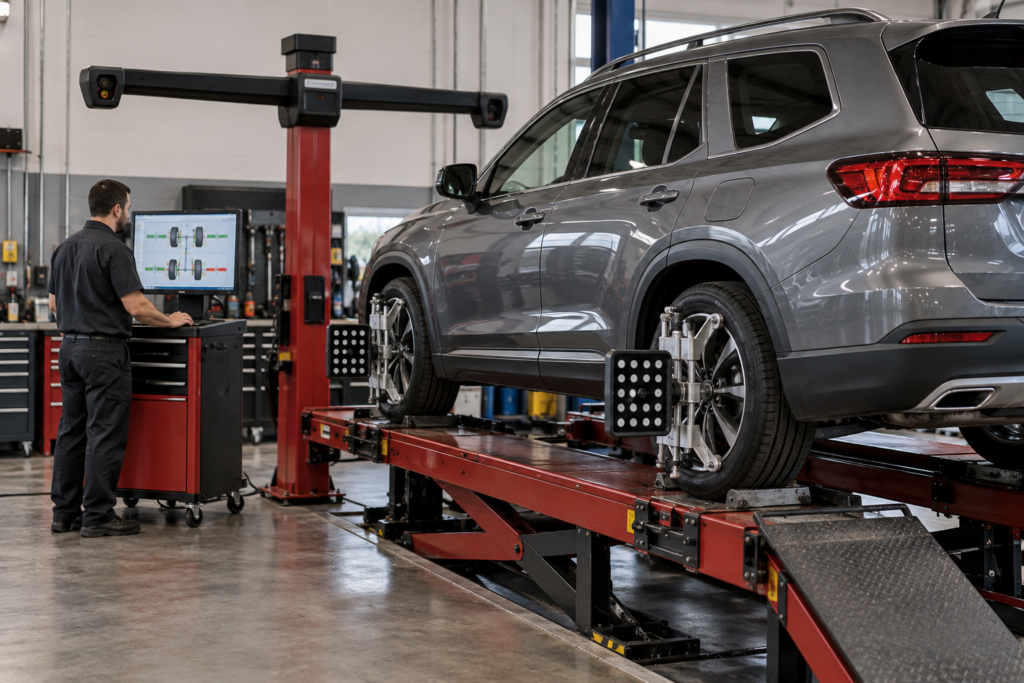
Deals On Wheels uses Hunter wheel alignment service for passenger vehicles and also provides steering and suspension service and general auto repair. If the tire itself needs replacement, our West Palm Beach tire shop handles new passenger tires for cars, SUVs and light-duty pickups.
Why fixing the cause protects the new tire
A new tire installed on a vehicle with the same alignment or suspension problem can begin wearing incorrectly almost immediately. Correcting the cause helps protect the replacement tire and can improve steering feel, braking stability and overall vehicle behavior.
Deals passenger-tire policy
Deals On Wheels & Tires sells and installs new passenger tires only for cars, SUVs and light-duty pickups. We do not advertise or install used or recap passenger tires. An uneven-wear inspection should address pressure, alignment and steering or suspension condition before the replacement tire begins the same wear pattern.
If one tire is disappearing faster than the rest, have the wear pattern and the vehicle checked before simply repeating the same replacement cycle.
¿Prefieres esta información en español? Consulta nuestra guía en español sobre llantas nuevas y alineamiento en West Palm Beach.
To schedule an uneven-wear inspection, steering/suspension check or Hunter wheel alignment, call (561) 847-4097 with the vehicle year, make and model, full tire size from the sidewall and the location of the abnormal wear.