“Mounting, balancing and alignment” are often grouped together when drivers shop for tires, but they are three different services. Knowing the difference helps West Palm Beach drivers avoid paying for the wrong fix and helps protect a new set of tires from vibration or uneven wear.
Tire mounting puts the tire on the wheel
Mounting is the physical process of removing a tire from the wheel and installing another tire. The technician must confirm the correct tire size and application, inspect the wheel and bead area, install the tire correctly and inflate it to the appropriate vehicle specification.
At Deals On Wheels & Tires, passenger cars, SUVs and light-duty pickups are serviced with new replacement tires only. Used and recap passenger tires are not offered. Current new-tire information is on the West Palm Beach tire shop page.
Balancing addresses weight variation around the rotating assembly
A tire-and-wheel assembly can have small weight differences around its circumference. Balancing measures that variation and uses wheel weights to reduce vibration as the assembly rotates. A vehicle that feels smooth at lower speeds but develops steering-wheel or seat vibration as speed rises may need the tire/wheel assemblies inspected and balanced.
Balancing does not change suspension geometry. It also cannot correct a bent wheel, damaged tire, worn suspension part or every source of vibration. Those conditions have to be identified separately.
Alignment changes wheel angles, not tire balance
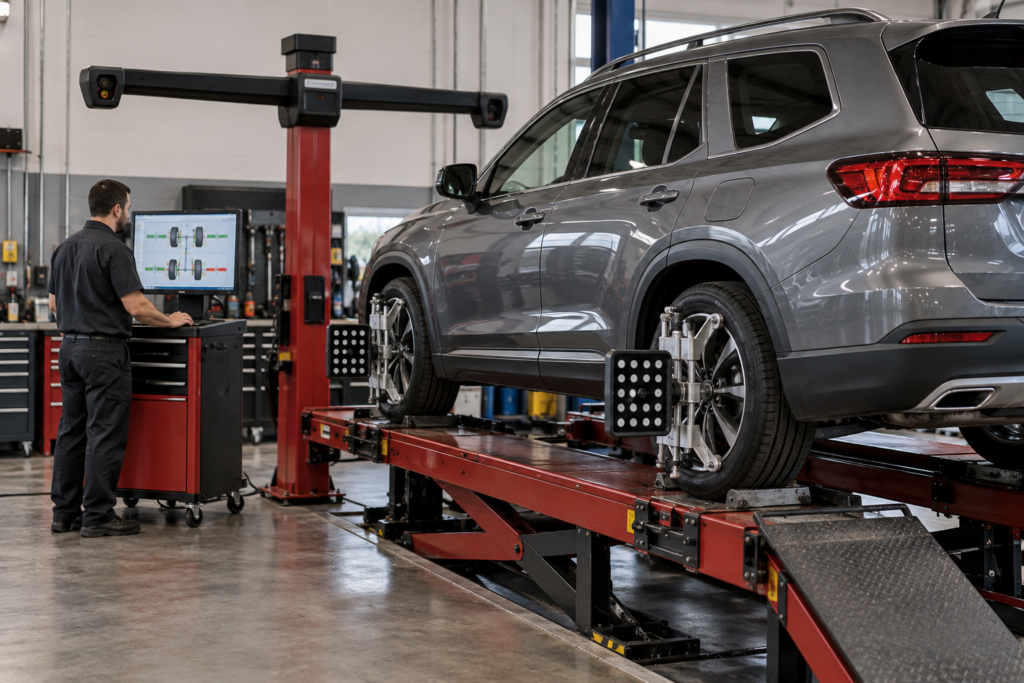
Wheel alignment measures and adjusts the vehicle’s alignment angles to specification where adjustment is available. Alignment symptoms can include an off-center steering wheel, directional pull and certain uneven tire-wear patterns. Deals On Wheels uses a Hunter alignment system for its wheel alignment service.
A perfectly balanced tire can still wear badly when the vehicle is out of alignment. Likewise, an aligned vehicle can still vibrate if a tire/wheel assembly is out of balance.
Which service should come first?
- Replacing a worn tire: start with correct tire selection and mounting, then balance the assembly.
- Vibration at speed: inspect tires, wheels and balance before assuming alignment is the cause.
- Pulling or off-center steering wheel: inspect tire pressures and condition, then measure alignment.
- Uneven tire wear: check pressure, alignment and steering/suspension condition.
- Vibration mainly while braking: follow a brake diagnostic path instead of assuming the tires caused it.
Do not replace parts from one symptom alone
Tire, wheel, steering, suspension and brake symptoms can overlap. A useful inspection separates them before money is spent. If the issue extends beyond tires and alignment, the in-shop auto repair service can evaluate the vehicle as a system.
New tires in West Palm Beach
When buying new passenger tires, compare the complete job: correct size and application, mounting, balancing, tire condition and whether alignment or mechanical inspection is actually indicated. Keeping these services separate makes it easier to solve the real problem instead of guessing. Call (561) 847-4097 with the full tire size from the sidewall or the vehicle year, make, model and trim so Deals On Wheels can check current new-tire availability and discuss whether balancing, a Hunter alignment inspection or another in-shop check fits the symptoms.