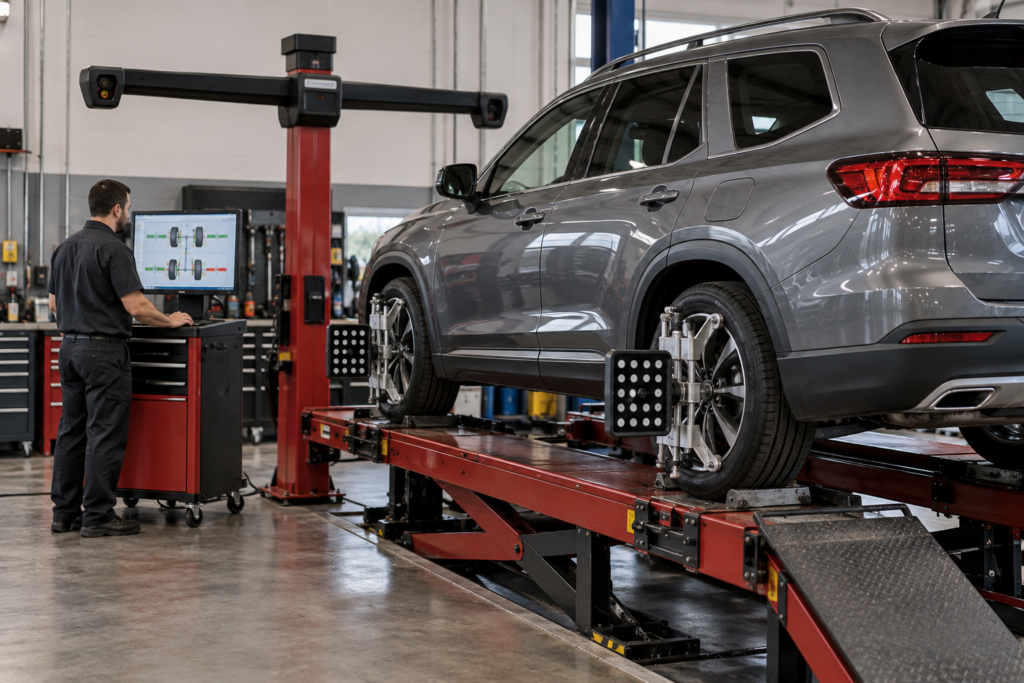
A steering wheel that begins shaking around highway speed often sends drivers back to the tire shop because speed-sensitive vibration commonly involves the tire and wheel assembly. But balance is not the only possible cause. Bent wheels, tire uniformity, loose or worn suspension parts and alignment-related wear can all change how the vehicle feels at speed.
When balance is the first thing to check
If the vibration started immediately after tires were installed or rotated, wheel balance and correct wheel mounting are logical first checks. A missing weight, debris between the wheel and hub, or an assembly that is not centered correctly can create vibration that becomes more noticeable as speed increases.
When the wheel itself may be involved
Potholes and curb impacts can bend a wheel without causing an obvious air leak. A wheel that is out of round can continue to vibrate even if the tire is balanced. The tire should also be inspected for a bulge, irregular wear, separated tread or other damage.
Does alignment cause vibration?
Alignment by itself is more commonly associated with pulling, an off-center steering wheel and uneven tire wear than with a classic speed-specific shake. However, alignment problems can create irregular wear that eventually contributes to vibration. That is why tire wear and alignment readings should be considered together rather than treated as unrelated services.
Suspension and steering checks matter too
Tie-rod ends, ball joints, control-arm bushings, wheel bearings and struts or shocks can all affect stability. If the vibration is accompanied by looseness, clunking, wandering or a change after braking, the inspection should extend beyond the tire balancer.
What to tell the technician
- The speed range where the vibration begins.
- Whether it is felt mostly in the steering wheel, seat or entire vehicle.
- Whether it changes while accelerating, coasting or braking.
- Whether the vehicle recently hit a curb or pothole.
- Whether tires, wheels, brakes or suspension parts were recently serviced.
See also our tire installation guide and alignment-after-curb-hit guide.
If the new tires feel harsh or sound noticeably louder rather than producing a speed-specific shake, use our new-tire ride and noise checklist to separate inflation, tread design, road-surface and installation questions before scheduling an inspection.
If the vibration becomes severe, worsens quickly, follows a hard impact, or appears with a tire bulge, visible tread damage or suspected loose wheel hardware, reduce speed safely and stop driving until the vehicle can be inspected. A steering and suspension inspection can check looseness and damaged components before balancing or alignment is treated as the only cause.
A vibration that changes mainly with throttle or vehicle load is a different diagnostic pattern from a shake tied to one road-speed range. See our vibration-under-acceleration guide and report whether the symptom changes while accelerating, coasting or braking.
A shake that appears in a repeatable highway-speed range is different from a sudden steering kick when one front tire crosses a pothole, bridge joint or uneven patch. If the wheel jerks mainly over bumps, use our steering-wheel kickback over bumps guide and note which side struck the bump, whether the symptom changes with speed, braking or acceleration, and whether there is a clunk or recent impact. That pattern can involve tire or wheel damage, steering linkage, suspension joints, bushings, struts or shocks; alignment alone should not be assumed to be the cause. If control feels unsafe or any tire or wheel damage is visible, stop driving and arrange an inspection.
West Palm Beach tire, balance and alignment service
Deals On Wheels & Tires installs new passenger tires only and provides mounting, balancing and Hunter Hawkeye Elite wheel alignment at 3292 Shawnee Ave #9, West Palm Beach. Call 561-847-4097 with your vehicle information, the full tire size from the sidewall and the speed where the vibration is most noticeable.