A curb strike does not have to bend a wheel dramatically to change how a vehicle tracks. If the steering wheel was centered before the impact and now sits slightly left or right while the car travels straight, that change deserves attention. The same is true if the vehicle begins pulling, the tire develops fresh edge wear, or the steering suddenly feels different.
Why the steering wheel can move off-center
Wheel alignment describes the angles of the wheels relative to the vehicle and road. Toe, camber and caster influence tracking and tire wear. A curb or pothole impact can change an adjustment, shift a component within its mounting range, or expose wear that was already present.
Alignment is not the only thing to inspect
An impact can also damage a tire sidewall, bend a wheel or stress steering and suspension parts. A proper inspection should not assume every pull or vibration is simply an alignment setting. A bent wheel, damaged tire or loose steering component needs to be identified before alignment adjustments are treated as the entire repair.
If the main change after the impact is steering free play, delayed response or constant correction on the highway—not just an off-center steering wheel—compare those symptoms with our loose-steering and highway-wandering guide. A Hunter alignment measurement can identify angle changes, but it does not replace an inspection for a damaged tire, bent wheel or worn steering and suspension parts.
If the curb or pothole impact is followed by a TPMS warning or repeated pressure loss, do not assume alignment alone explains the problem. A bead leak, bent wheel, valve or TPMS service-component leak, tread puncture or sidewall damage needs a separate tire inspection; use our pothole tire air-loss guide to record the tire position, cold pressure, loss pattern, pull or vibration, and visible damage. Stop driving if the tire is visibly low or bulged, the wheel is cracked, or the vehicle begins shaking or pulling sharply.
Clues that justify an alignment check
- The steering wheel no longer sits centered on a level road.
- The vehicle pulls consistently to one side.
- One front tire begins wearing faster on an inside or outside edge.
- The vehicle recently hit a curb, deep pothole or road debris.
- Steering feels different after suspension or steering work.
- New tires are being installed after the old set showed uneven wear.
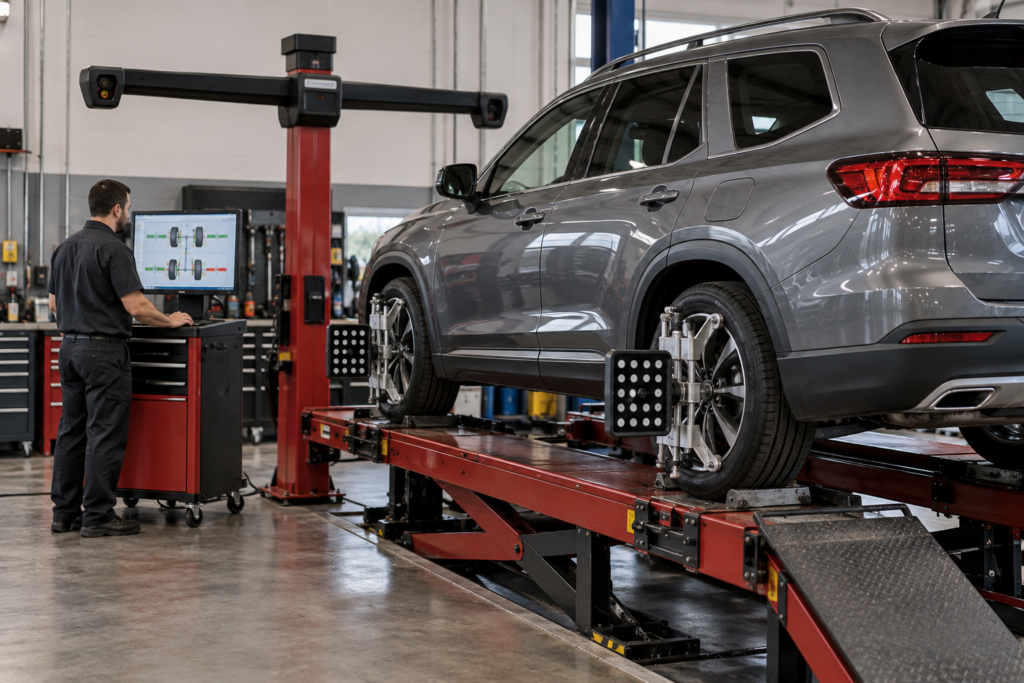
Deals On Wheels uses a Hunter Hawkeye Elite alignment system for in-shop wheel alignment. Learn more on our wheel alignment page.
Balancing and alignment solve different problems
Balancing corrects weight distribution in the wheel-and-tire assembly. Alignment corrects wheel angles. A vibration at highway speed can point toward balance, tire or wheel issues; a pull, off-center steering wheel or directional tire wear is more likely to justify an alignment inspection. Sometimes both services are appropriate, but they are not interchangeable.
Why this matters before new tires
New tires can restore tread depth and a more uniform contact patch, but they cannot correct an underlying alignment or suspension problem. If the old tires were worn unevenly, correcting the cause helps protect the new set. Visit our new tire service and auto repair pages for related in-shop services.
Deals On Wheels & Tires is located at 3292 Shawnee Ave #9, West Palm Beach, FL 33409. Shop hours are Monday-Friday 8:30 AM-5:30 PM and Saturday 8:30 AM-2:00 PM. Call 561-847-4097 with the vehicle year, make and model and the full tire size from the sidewall to discuss a Hunter alignment, tire or steering-and-suspension inspection after a curb or pothole impact.